Adam’s Hand started because I was looking for a challenge. For a mechanical engineer, few problems are as interesting as the human hand. I still think of it as the most mechanically complex structure in the body: fast enough to catch a falling glass, strong enough to carry a suitcase, robust enough to take knocks all day, and light enough that we never notice its weight. Each of those properties pulls against another, and the hand balances them all.
My bachelor’s thesis was already a kinematic study of the hand, and a study like that starts by counting. Before the numbers, though, two experiments you can do while reading.
Rest your hand palm up on the table and try to bend only the last joint of your ring finger, keeping the middle one straight. Most people can’t.
Now hold the middle segment of that finger still with your other hand and try again. This time the tip bends.
Keep that in mind: it explains a good part of this article.
First: an attempt to bend the fingertip joint independently. Then: holding the middle segment still allows the fingertip to bend.
A few definitions first
A degree of freedom (DoF) is one independent coordinate of a mechanism: one number you need to describe its position. A degree of actuation (DoA) is one independent command: a motor, or a muscle the brain can drive on its own. Two motors that can only move together count as one. When a mechanism has more of the first than of the second (DoF > DoA), it is underactuated, and some of its joints move without a command of their own. One caveat: muscles and tendons can only pull, so controlling a set of joints independently takes at least one more of them than there are joints. With fewer, at least one joint is left without a command of its own.
One caveat: muscles and tendons can only pull, so controlling a set of joints independently takes at least one more of them than there are joints. With fewer, at least one joint is left without a command of its own.
In our engineering documents we sort joints into four kinds, according to where their power comes from and what decides where they stop:
- an actuated joint is driven and commanded on its own;
- an underactuated joint is driven, but not commanded on its own: where it stops is settled by contact with the object;
- a passive joint receives no power at all and is moved only by external forces;
- a coupled joint is driven through another joint and always follows it: it adds no degree of freedom of its own.
The literature does not always draw these lines in the same place, so this is our convention, but it is the one I will use here.
Twenty-seven, then twenty-one
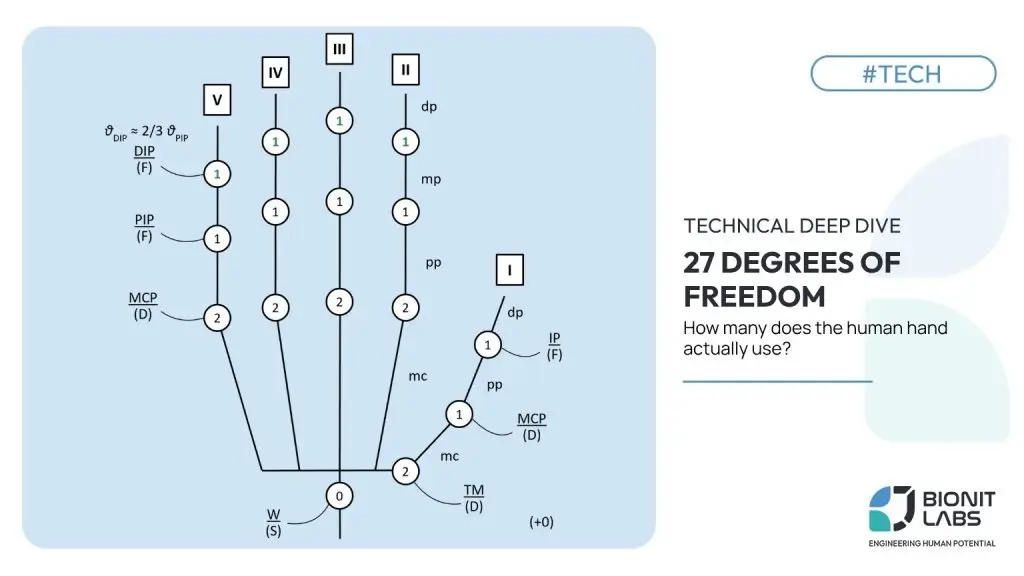
The model most widely used to describe the hand, introduced by Lee and Kunii in 1995, counts 27 degrees of freedom (Lin, Wu and Huang, 2000, IEEE Workshop on Human Motion; Bullock, Borràs and Dollar, 2012, IEEE BioRob). Each of the four long fingers has four: three to bend its three joints, and one to move sideways at the knuckle. The thumb has five. Six more place and orient the whole hand in space. The hand itself has 21.
That count already leaves something out. The bones of the palm are treated as fixed, while in reality the metacarpals of the ring and little fingers can move a little, cupping the palm. Models that include this add one to three degrees of freedom in the palm (Bullock et al., 2012).
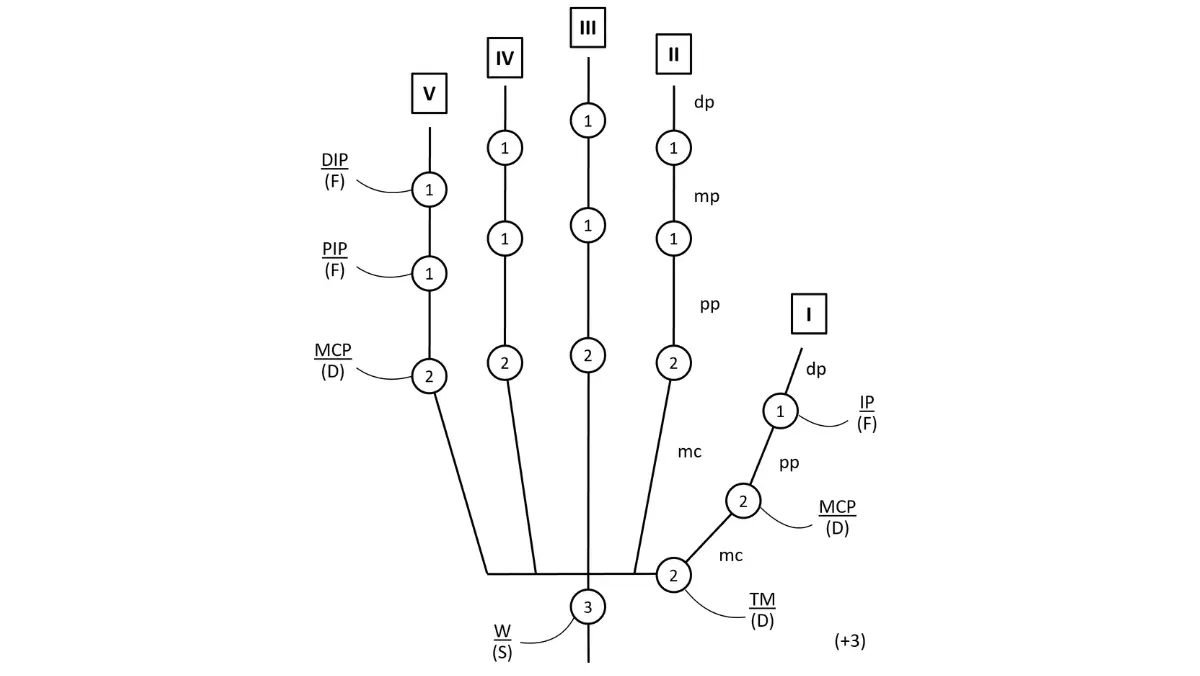
But 21 is not the number of movements the hand controls independently.
The joint without a muscle
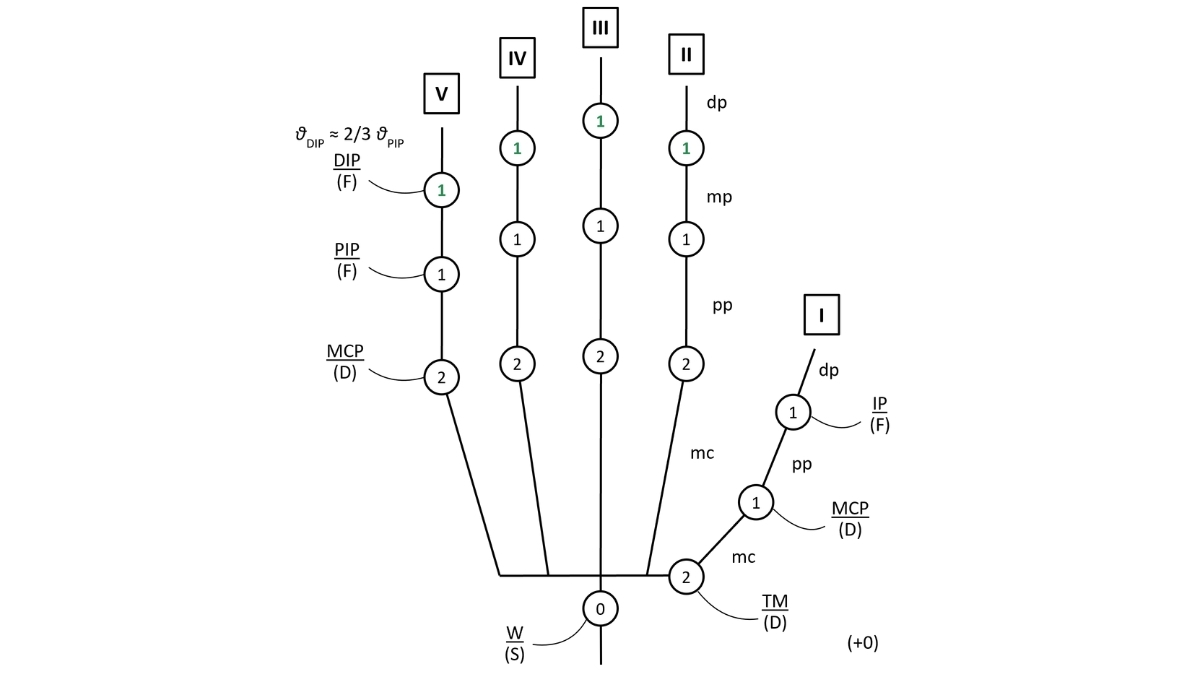
Take the constraints one at a time. The four long fingers bend in a plane, except at the knuckle (Lin et al., 2000). The sideways motion of the thumb’s knuckle is small enough that kinematic models neglect it (Kim, Youm and Chung, 2002, IEEE HAPTICS). That leaves 20.
Then there is the joint from the experiment. The last joint of each finger has no muscle of its own: it is moved by the deep flexor, a tendon that runs the length of the finger and crosses the middle joint on its way to the tip, and by the extensor apparatus, which attaches to both the middle and the last phalanx. With the finger free, the two joints therefore move as one (Leijnse, 1997, Journal of Biomechanics). In 1991 Rijpkema and Girard measured several people and found that the last joint bends about two thirds as much as the middle one (Rijpkema and Girard, 1991, Computer Graphics). That is an approximation: a more recent study measured ratios between about 0.5 and 0.8 in free motion, depending on the finger (Roda-Sales, Sancho-Bru and Vergara, 2022, PeerJ).
The coupling holds only while the finger is unloaded. Block the middle segment, as in the second experiment, and the deep flexor keeps pulling the tip: it is the same test clinicians use to check that tendon. Press on the fingertip, as in a pinch, and the last joint can be pushed back while the middle one keeps bending: in the same study, the index finger’s ratio dropped to 0.44 while people handled objects.
In the terms above, the last joint is underactuated. It is driven, but not commanded on its own, and where it stops is decided by what it meets.
Leijnse also showed what the coupling saves. Moving in its own plane, a finger with three independent joints would need at least four muscles to be fully controlled. Because the last two joints move as one, three are enough.
Set aside the four fingertip joints and, with the hand held still in space, 16 of the 20 degrees of freedom move independently in free motion. The fingers also limit one another: not everyone can bend the little finger without the ring finger following, and how far each knuckle bends depends on its neighbours (Lin et al., 2000).
How many the brain uses
The nervous system uses even fewer. Santello, Flanders and Soechting asked five people to shape their hand around 57 imagined objects, from a cherry to a frying pan, and recorded 15 joint angles. On average, two patterns of joint motion explained about 84% of the variation. The remaining components were small but were not noise, and the authors estimated at least five to six effective degrees of freedom (Santello et al., 1998, Journal of Neuroscience).
Nor can the fingers be driven separately. Press as hard as you can with one finger and the others press too, involuntarily, with between 10.9% and 54.7% of their own maximum force, most strongly next door (Zatsiorsky, Li and Latash, 1998, Biological Cybernetics).
And how many function needs
The most direct test came from Montagnani, Controzzi and Cipriani (Scientific Reports, 2016). Ten able-bodied volunteers performed a standard hand-function assessment, the SHAP, wearing orthoses that constrained their own hands. With independent long fingers they scored 97. With the four long fingers coupled into a single degree of freedom, and the thumb still able to flex and move sideways on its own, they scored 95.5, a difference that was not statistically significant. Closing the whole hand as one degree of freedom gave 91.3. Independent fingers made a difference only in tip and tripod grasps. The authors point out that their subjects had an intact nervous system, so the comparison with an artificial hand is indicative rather than direct.
Those grasps are a small share of real use. Recording people at work, Zheng, De La Rosa and Dollar found that six grasp types covered nearly 80% of a housekeeper’s grasping time. The tripod grasp accounted for 1.4% of it, and for 10.6% of a machinist’s (Zheng et al., 2011, IEEE ICRA).
Where we put the motors
Which raises the obvious question. Several of the newest robotic hands drive twenty or more joints, each with a motor of its own. For how many of the things we do with our hands do we really need to control twenty degrees of freedom independently, when our own hand rarely does?
Put together, the picture is consistent: most of the hand’s nominal DoFs add little to grasping. What keeps most of the function is closing the long fingers together, with a thumb that moves on its own.
That is how Adam’s Hand Plus allocates its three motors:
- one, in the palm, closes the four long fingers through the differential mechanism I described in One motor, four fingers: the mechanism behind Adam’s Hand;
- the other two serve the thumb: one flexes it, the other rotates it.
The hand has ten driven degrees of freedom. The two of the thumb are actuated, one motor each; the eight joints of the long fingers are underactuated: one motor drives them all through the differentials, and where each one stops is decided by contact with the object. The long fingers are coupled through differentials rather than rigidly, so each one still adapts to the shape it meets.
Joint group | Human hand | Adam’s Hand Plus |
|---|---|---|
Knuckle flexion (MCP joint), four long fingers (4) | Actuated | Driven by one motor through the differentials |
Middle-joint flexion (PIP joint), four long fingers (4) | Actuated | Driven through the differential gear train inside each finger |
Fingertip-joint flexion (DIP joint), four long fingers (4) | Coupled to the middle joint in free motion, underactuated under contact | Absent (two phalanges per finger) |
Sideways knuckle motion (MCP joint), four long fingers (4) | Actuated | Absent |
Thumb base (CMC joint) (2) | Actuated | One motorised rotation of the metacarpal |
Thumb knuckle (MCP joint) and tip (IP joint) flexion (2) | Actuated | One motorised flexion of a single phalanx |
Sideways thumb-knuckle motion (MCP joint) (1) | Small, neglected in the model | Absent |
Total DoFs | 21 | 10 driven on 3 motors: 2 actuated, 8 underactuated |
| Joint group | Knuckle flexion (MCP joint), four long fingers (4) |
|---|---|
| Human hand | Actuated |
| Adam’s Hand Plus | Driven by one motor through the differentials |
| Joint group | Middle-joint flexion (PIP joint), four long fingers (4) |
| Human hand | Actuated |
| Adam’s Hand Plus | Driven through the differential gear train inside each finger |
| Joint group | Fingertip-joint flexion (DIP joint), four long fingers (4) |
| Human hand | Coupled to the middle joint in free motion, underactuated under contact |
| Adam’s Hand Plus | Absent (two phalanges per finger) |
| Joint group | Sideways knuckle motion (MCP joint), four long fingers (4) |
| Human hand | Actuated |
| Adam’s Hand Plus | Absent |
| Joint group | Thumb base (CMC joint) (2) |
| Human hand | Actuated |
| Adam’s Hand Plus | One motorised rotation of the metacarpal |
| Joint group | Thumb knuckle (MCP joint) and tip (IP joint) flexion (2) |
| Human hand | Actuated |
| Adam’s Hand Plus | One motorised flexion of a single phalanx |
| Joint group | Sideways thumb-knuckle motion (MCP joint) (1) |
| Human hand | Small, neglected in the model |
| Adam’s Hand Plus | Absent |
| Joint group | Total DoFs |
| Human hand | 21 |
| Adam’s Hand Plus | 10 driven on 3 motors: 2 actuated, 8 underactuated |
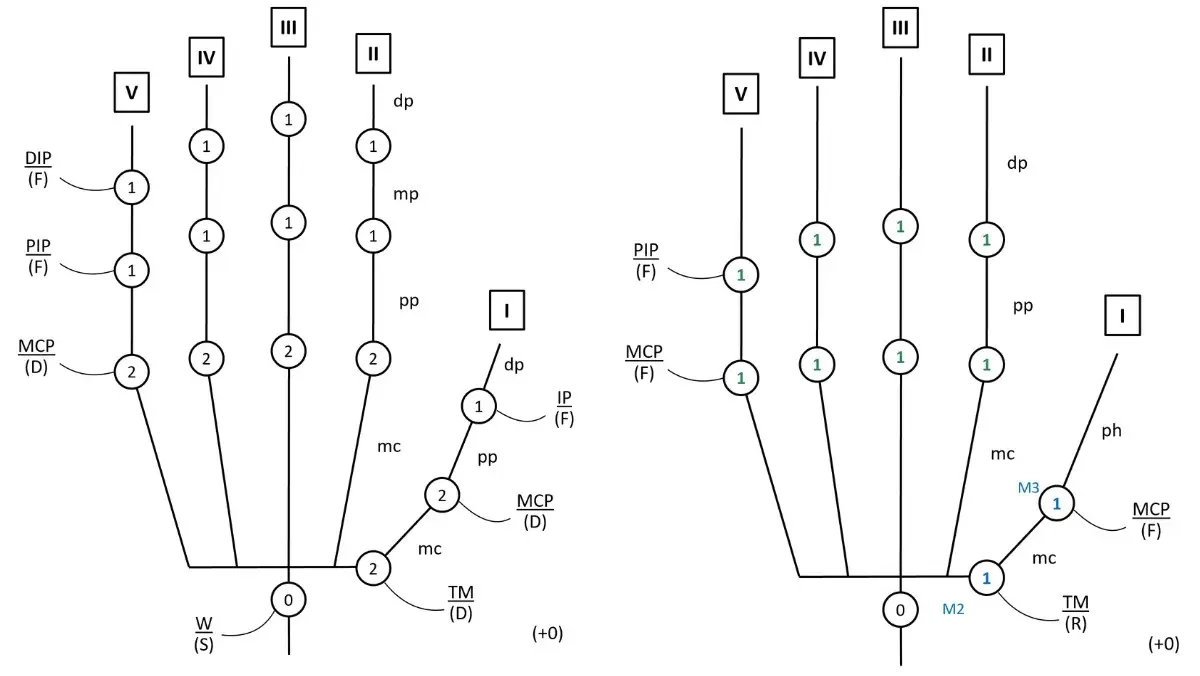
There is also a parallel with the finger experiment, though not a copy. Adam’s Hand Plus has two phalanges per finger, not three, so it has no equivalent of the human fingertip joint. Between its two phalanges, however, the same thing happens: when the proximal phalanx stops on the object, the distal one keeps closing. The proximal phalanx closes ahead of the distal one by design: a fingertip that touches first may push the object out of the hand. In the human finger the superficial flexor also gives the middle joint a partly independent command; Adam’s Hand has nothing equivalent.
A review of kinematic hand models makes a point I agree with: when a hand is designed with fewer degrees of freedom than the human one, the choice of which ones to keep largely decides how well it performs (Bullock et al., 2012).
I started out wanting to reproduce the hand. Counting its joints taught me something more useful: the hand does not drive all of them either. It drives a few, and lets the others find their place on the object.